
Exquisite choice.
There are few things I can now imagine to be of any material interest to me. Not because I stand above such matters—nor below them—but because I have already lived so thoroughly among them. I remain, in spirit, a devoted profligate, though one now tempered by a measure of restraint and reason. The great pleasure lies not in acquisition, but in recollection; I revisit what I own as one might return to a favourite room—daily, and with intention.
This morning, however, in spite of my cultivated indifference—whether from satiety or simple logic—I received, quite by chance, two retail communications (by way of Canada Post, no less): one from a car dealership, the other from an ancient friend.
The former was from the General Sales Manager of the Cadillac dealership from which I purchased a car in 2024. I wrote to him—more as a matter of statistical empiricism than anything else—informing him that since that purchase I have acquired three new cars: two 2025 models and one 2026. I ventured the opinion that neither he nor his principal is likely to offer me anything not already encompassed within our shared ambitions.
The second Canada Post envelope—rarer by far in this age—contained a certifiably delicious gift from my dear friend, Miss Nancy Noodles, whom I have known for over fifty years. We were, as the saying goes, birds of a feather.
More precisely, we were a classic duo—most often found in a barroom, such as the Piccadilly Tavern, laughing freely and in the company of an equally longstanding friend, then a professor of law, now residing in the South Pacific.
The Pic—on Grafton Street in Halifax—was one of those places that seemed to exist slightly ahead of its time. Yet, until about 1971, women were not permitted entry into such establishments. When the law changed, Nancy and I made a point of attending—only to discover that, while women were now admitted, they were not accommodated. There were no powder rooms.
Nancy, undeterred, marched directly into the men’s room. Moments later, she emerged with perfect composure. No one objected. A small victory, perhaps—but a victory nonetheless, and entirely in keeping with her character.
But I stray from the true subject: her gift.
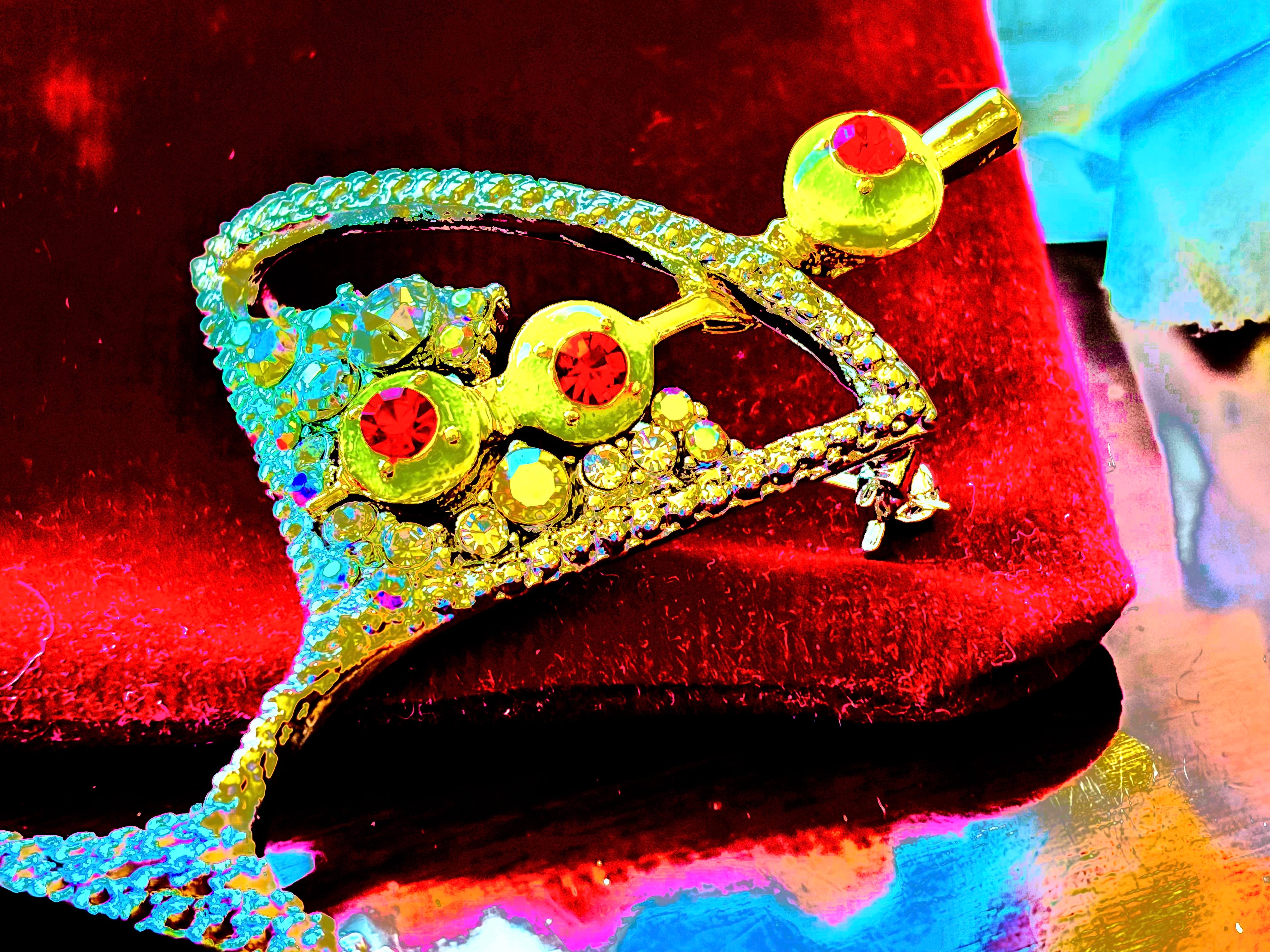
It is a brooch. Not merely a brooch, but one with a certain poetic history, accompanied by a card bearing our old refrain:
One martini,
Two martini,
Three martini—floor!
I shall keep the card naturally—filed among other private relics of a well-lived life.
I have long been an advocate of the brooch. The inclination may well trace back to my prep school days in the Highland Cadet Corps. The Scots, after all, understand the authority of an accessory: the sgian-dubh, the kilt pin, the sporran—each an assertion as much as an ornament.
Over the years, I have accumulated a modest collection: a piece from my time with the Fraser Highlanders; a more recent ornamental bee (that curious intersection of elegance and kitsch); even a Cadillac brooch, gifted by my partner’s nephew. Earlier still, I acquired them vicariously—purchasing for girlfriends, and later relinquishing many to my sister and nieces when I conceded they were not, strictly speaking, mine to wear.
Yet Nancy’s gift has revived the old enthusiasm.
I cannot determine its provenance, which only deepens its appeal. It is, unmistakably, a well-made piece. I have examined it—closely. The green olives, plump and assured, are skewered on a finely balanced swivel; they speak more persuasively than the diamonds. The perimeter is delicately engraved, suggesting a halo of minute gems, while the olives themselves are set with subtle ruby accents, edged in near-imperceptible gold. Even the clasp—requiring a certain patience—rewards a careful hand with quiet precision.
This is an ornament made for conviviality. It invites laughter, a touch of theatre, and the easy gaiety of shared company.
It arrived wrapped in small squares of white tissue, nestled within a red velvet pouch tied with a matching cord.
The perfect gift. The ideal theme. And, I suspect, entirely intentional.