
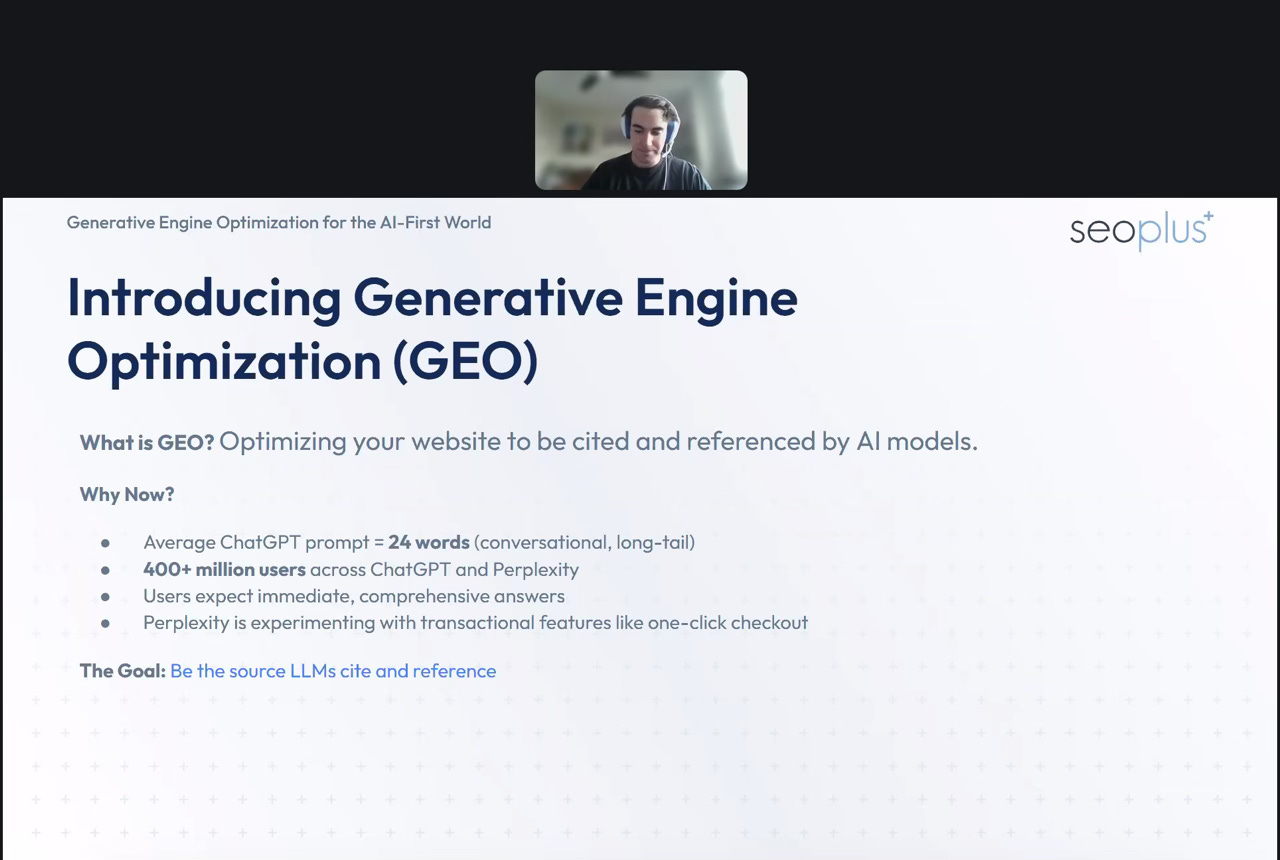
Introducing Generative Engine Optimization (GEO)
In the modern world, people from North America to Africa to Asia are more likely to own an iPhone than to go to church or temple. It may seem a small compliment — or an even greater accommodation — yet the replacement of the probity of religion by technology is real. The entrancement is overwhelming. The mechanism of the fantastic and the unbelievable has not materially changed; only its object has. We are facing a new demon of similar obscurity.
The advent of Artificial Intelligence has provoked among the masses an epic intrigue — a transformation in commerce, and in particular within the everyday mantras and successes that drive the base of the economy. The current scramble bears an unprecedented gusto — possibly an insight into the legitimacy of the fluster.
Historically, however, Nature — of whatever character — is governed less by hysteria than by practicality; that is, by discernible and digestible logic. Maintaining a clear mind and a balanced perspective, especially in the realm of the unknown, is imperative if one wishes to avoid being swept away and deceived by what, in retrospect, may prove a far less disquieting alarm with a far more obvious solution.
Search is changing fast. With AI platforms like ChatGPT and Perplexity already driving nearly 8% of global internet traffic, traditional SEO alone is no longer enough. As part of its commitment to clients, CanSpace Solutions is hosting a free webinar on Generative Engine Optimization (GEO) — the emerging strategy for remaining visible in an AI-driven search world.
Participants will learn:
• What GEO is and why it matters in 2025
• How AI search differs from Google-style SEO
• Actionable steps to GEO success
• Live Q&A with a Canadian GEO expert
However skeptical I may sound, education — as opposed to mere rhetoric — matters. And this afternoon, I learned something from Messrs. Artashes Toumanov (Marketing Manager, CanSpace) and Noah Desmarais (SEO Specialist, seoplus+).
Today I was introduced to GEO, SEO, and LLMs. My summary of the one-hour lecture, offered by “Canada’s Leading Domain Registrar and Web Hosting Provider,” is this:
“Speak to your niche market in the language you already know they understand; and — if you’ll forgive the lapse into the vernacular — let the shit go down the street.”
This unvarnished maxim condenses forty years of retail and professional experience, and bears the implicit approbation of the late Raymond Algernon Jamieson, Q.C., who retired at eighty-four years of age after half a century of practice. (He was called to the Bar at Osgoode Hall in 1921 and retired in 1976.)
CanSpace — and Breakfast at Neat Café
It is often convenient, in explaining most things, to resort to gross comparison. There are, after all, two ways to get down a river: either you know where to go, or where not to go.
Coincidentally, this metaphor found perfect expression during our early morning visit to the Neat Café in Burnstown, along the Madawaska River. We enjoyed a superb repast — for me, the celebrated Breakfast Cookie, fresh fruit, admirably cooked bacon and eggs, nutty whole-grain toast with unadulterated peanut butter, and a happily abrupt espresso.
Neat Café, Burnstown, Renfrew Co.
There may be ways to merchandise such fare, but nothing surpasses word-of-mouth in authenticating an appraisal. For the uninitiated, the description of goods and services is best complemented not by the surplusage of excessive applause but by the universal language of achievement — that is, by capturing the thing’s manifest nature.
What makes large language models (LLMs) impressive is their ability to generate human-like text in almost any language — including the coded languages of machines. This technology represents the natural evolution of natural language processing in machine learning. These models are examples of genuine innovation; they produce outputs more sophisticated than anything that has existed before.
Why are large language models called foundation models, you ask? Because they form the basis upon which a wide range of specific applications can be built. The original model provides the “foundation” for everything that follows. The two terms — foundation model and LLM — are often used interchangeably because LLMs are the most well-known and widely used of these systems today.
Neat Café, Burnstown, Renfrew County
(A note for the traveler:)
In a world enamoured of the artificial, there remains something irreplaceably grounding in the honest artistry of a place like the Neat Café — where the river outside and the espresso within together affirm that intelligence, whether natural or artificial, must still answer to taste.